
“Calculating the Padel Court Cover Cost is the #1 priority for club owners and investors worldwide”
This is the #1 question we receive from club owners and investors worldwide. While the short answer is “it depends,” that doesn’t help you plan your budget.
Unlike standard buying standard furniture, investing in an Aluminum Alloy Sports Tent is a construction project. The price varies significantly based on safety standards, aesthetics, and durability.
At Sepi Tent, we believe in transparency. In this guide, we break down the 5 main factors that determine the final price of your padel court cover, so you can make a smart investment.
1. Structural Dimensions (Single vs. Multi-Court)
The size of your structure is the most obvious cost driver. However, the design layout plays a crucial role in cost efficiency.
Single Court Cover: Covering just one court is relatively more expensive per square meter due to the ratio of materials.
Multi-Court Structure: If you cover 2, 3, or 4 courts under one large clear-span roof, you save significantly on columns and installation time.
Pro Tip: If you have the space, covering multiple courts with one large Polygon or Curved Roof structure is more economical than building separate covers for each court.
2. Wind and Snow Load (The “Invisible” Cost)
This is where the price gap between a “Cheap Tent” and a “Professional Structure” happens.
If your club is located in a coastal area (like Florida or Spain) prone to typhoons, or a northern region with heavy snow, we must increase the thickness of the 6061-T6 Aluminum Alloy profile.
Standard Area: Lower aluminum weight = Lower cost.
Extreme Weather Zone: Higher aluminum weight = Higher cost, but guarantees safety.
Warning: Never sacrifice wind load ratings for a lower price. A collapsed roof will cost you 10x more in damages and lost revenue.
3. Eave Height (Playability vs. Budget)
For professional Padel tournaments (like World Padel Tour standards), the vertical clearance is critical.
Standard Height (7m – 8m): Sufficient for most recreational clubs and keeps costs down.
Tournament Height (10m+): Required for professional matches. This requires larger aluminum profiles to support the height, increasing the budget.
4. Sidewalls: PVC Fabric vs. Tempered Glass
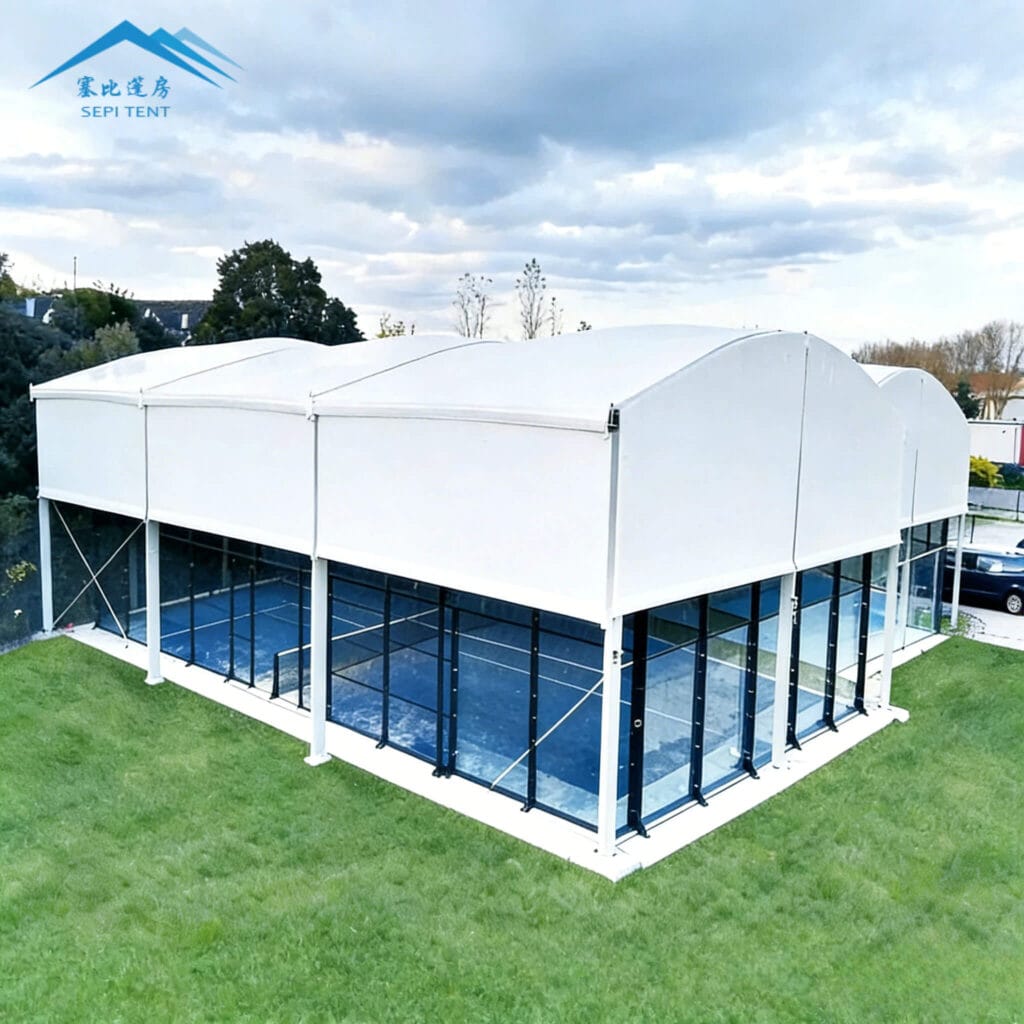
The choice of walls has the biggest impact on the aesthetic appeal and the final price.
PVC Fabric Walls: The most cost-effective option. It offers weather protection and can be customized with your club’s logo.
Tempered Glass Walls: The premium choice. As seen in our high-end projects, glass walls provide natural light, a luxurious feel, and a better viewing experience for spectators.
Sandwich Panels: Best for thermal insulation in very hot or cold climates.
Cost Comparison: Glass Walls are approximately 2-3 times more expensive than PVC walls, but they allow you to charge higher membership fees due to the premium experience.
5. Roof Material: Translucency and Insulation
Translucent PVC: Allows sunlight in during the day, saving you money on electricity (lighting).
Block-out PVC: Blocks 100% of UV and heat, keeping the interior cooler in summer.
Double-Layer Inflatable Roof: The most expensive option, but provides excellent thermal insulation and prevents condensation dripping on the court.
Summary: Padel Court Cover Cost vs. Long-term ROI
When calculating the cost of a Padel Court Cover, don’t just look at the initial price tag. You must look at the ROI (Return on Investment).
An outdoor court depends on the weather. An indoor court operates 365 days a year, rain or shine.
Outdoor Court: ~200 operational days/year.
Covered Court: 365 operational days/year.
By investing in a high-quality Sepi Tent structure, you effectively double your operational hours and revenue potential.
Ready to get an exact quote for your club? Since every project is unique, we offer a free consultation. Tell us your location and number of courts, and our engineers will provide a detailed quote within 24 hours.
-1536x673.png)